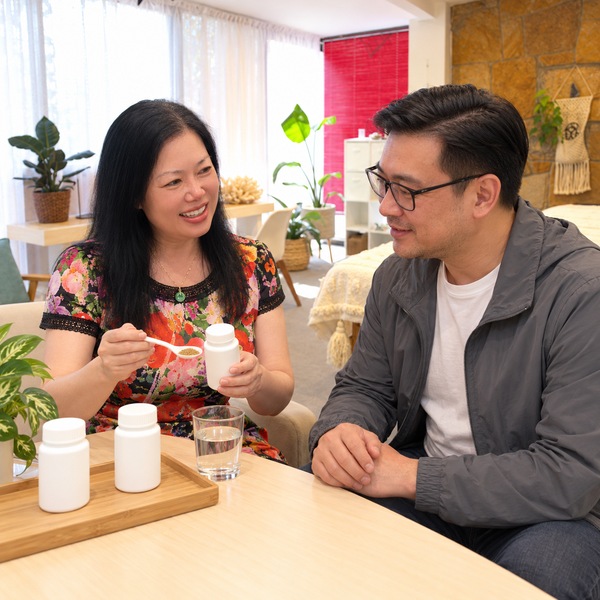
Herbal formulas once came from a clay pot; today they arrive as granules in labelled bottles. Four things to check when you collect one, and the signs that mean you should ask first.
Traditionally, Chinese herbal formulas were cooked at home in a clay or ceramic pot, sometimes for an hour or more. Concentrated granules developed partly to make traditional formulas easier to keep up with. Dr Christine Shen, Acupuncturist, supplies Chinese herbal medicine in granule containers, and the clinic does not supply ready-cooked pouches or raw herbs.
A convenient bottle still needs a clear identity and instructions you understand. Its colour or appearance cannot tell you which formula it holds or how to use it. The label and the written directions are what identify it.
When you collect a bottle, four points are worth checking with Christine:
Convenience should leave you better informed, not less.
If the packaging is damaged or the seal broken, or if the granules look, smell or clump unexpectedly, set the bottle aside and ask before using it. Granules can vary in shade, so colour alone is not a reliable guide either way.
Keep the label and directions with the bottle so the formula name is always at hand. If your GP or another doctor changes a medicine while you are taking the granules, pass that news on to Christine and your pharmacist. Should a new symptom appear, check in before the next dose rather than adjusting the amount yourself.
Patients of the Freshwater clinic who remember older herbal routines are welcome to ask how the classical method has given way to modern containers, and what has stayed the same: careful identification and clear information.
Copyright© 2002-2026 visuallink© SaaS - Web Hosted Solutions, Design and Maintenance by Visual Link IT Pty Ltd - Software Solutions

Please Login or Sign up to be able to comment